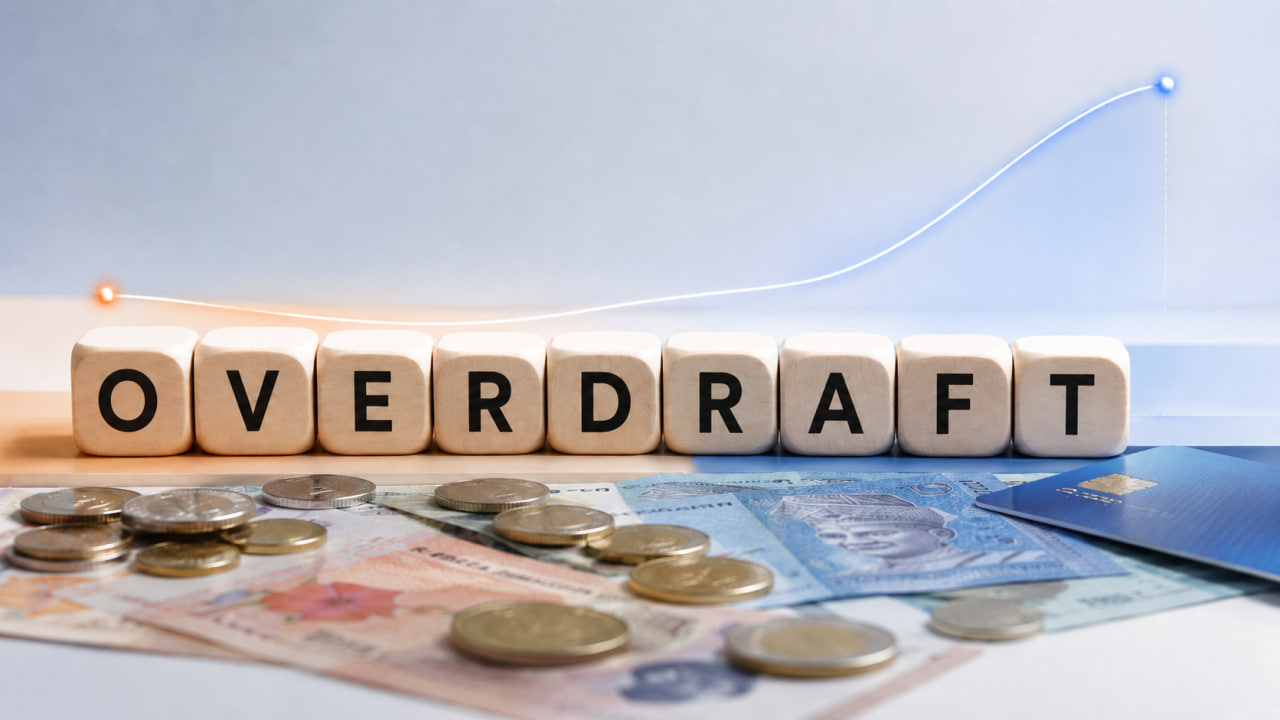
An overdraft facility is a short-term credit arrangement attached to a current account that lets you withdraw or spend more money than you actually have, up to an agreed limit. Instead of a payment bouncing or a transaction being declined, the bank covers the shortfall and charges interest on the amount you use. Think of it as a safety net built directly into your everyday banking account rather than a separate loan product you have to apply for each time you need cash. Banks often refer to this simply as an "OD facility," and it functions as a form of revolving credit: the limit resets as you repay, so you can draw on it again without reapplying.
Because an overdraft account sits on top of a current account, it is usually one of the fastest forms of borrowing to access once approved. There is no need to draw down a lump sum in advance; you simply spend, and the overdraft interest rate applies only to the portion of the limit you have actually used.
How Does an Overdraft Account Work?
Once a bank approves an overdraft facility, the agreed limit becomes available on your current account. If a payment, cheque, or withdrawal exceeds your available balance, the account moves into negative territory instead of being rejected, provided the shortfall stays within the approved limit. The bank then charges interest daily on the outstanding drawn balance, and in many cases a commitment fee on any unused portion of a larger facility.
Overdraft interest in Malaysia is typically pegged to the Standardised Base Rate (SBR), which moves in line with the Overnight Policy Rate (OPR) set by Bank Negara Malaysia. When the OPR changes, the SBR - and therefore your overdraft interest rate - adjusts accordingly. As of mid-2026, the OPR has been held at 2.75%, keeping overdraft pricing relatively stable for existing facility holders.
Repayments are flexible by design. There is usually no fixed monthly instalment; instead, any deposit into the account automatically reduces the outstanding balance, and interest is calculated only on the daily drawn amount. This is very different from a term loan, where you commit to a fixed repayment schedule regardless of how much of the credit you actually use.
Types of Overdraft: Authorised vs Unauthorised
Not all overdrafts work the same way, and the difference in cost between the two types can be significant.
- Authorised (arranged) overdraft: You apply for this in advance, the bank assesses your income and credit profile, and you are given a set limit with a disclosed overdraft interest rate before you ever use the facility.
- Unauthorised (unarranged) overdraft: This happens when you spend beyond your available balance, or beyond an existing authorised limit, without prior agreement. Banks may allow this occasionally as a courtesy, but it typically comes with higher charges and can affect how the bank views your account going forward.
- Secured overdraft: Backed by collateral such as a fixed deposit, unit trust holdings, or property, this type usually carries a lower overdraft interest rate because the bank's risk is reduced.
- Unsecured overdraft: Approved purely on income and creditworthiness, with no collateral pledged, which generally means a higher rate and a more conservative limit.
Falling into an unauthorised overdraft is one of the most common ways borrowers end up paying far more than they expected, so it is worth checking your account terms carefully before you rely on one.
Overdraft Interest Rates and Fees to Expect
Overdraft pricing varies by bank, by whether the facility is secured or unsecured, and by the size of the limit. Based on current product disclosure sheets from major Malaysian banks, a few patterns stand out:
- Secured overdrafts backed by property or fixed deposits often start from roughly 4% to 5% per annum, since the collateral lowers the bank's risk.
- Unsecured personal or business overdrafts are commonly priced several percentage points above the SBR, with excess-usage interest charged at a higher rate if you exceed your approved limit.
- A commitment fee, often around 1% per annum, typically applies once your total overdraft facilities exceed RM250,000 - this is the price of keeping the unused portion of a large credit line on standby.
- Secured facilities generally require a minimum collateral value, commonly starting from around RM10,000 in fixed deposits or approved investments, in exchange for the lower rate.
- Interest is calculated daily on the outstanding balance, so the actual cost depends heavily on how long and how much of the facility you use, not just the quoted annual rate.
Because pricing differs so much between banks and account types, it is worth requesting a product disclosure sheet before signing up, and comparing the effective cost rather than the headline overdraft interest rate alone.
Overdraft vs Personal Loan vs Credit Card
An overdraft facility is not always the cheapest or most suitable way to borrow. The right choice depends on how long you need the money and how predictable your cash flow is.
|
Feature |
Overdraft Facility |
Personal Loan |
Credit Card |
|
Best for |
Short-term, irregular cash flow gaps |
Larger, one-off planned expenses |
Everyday purchases, short revolving balances |
|
Repayment structure |
Flexible; no fixed instalment |
Fixed monthly instalments |
Minimum monthly payment |
|
Interest charged on |
Only the amount drawn, daily |
The full approved amount from disbursement |
Outstanding balance after the interest-free period |
|
Typical cost |
Moderate, varies by collateral |
Often lower for larger, longer-term sums |
Can be highest if balances are carried long-term |
As a rule of thumb, an overdraft account is best treated as a buffer for genuine short-term shortfalls, not as a long-term source of funds. If you find yourself permanently drawing close to your limit, a personal loan with a fixed repayment plan is usually the cheaper and more disciplined route.
Pros and Cons of Using an Overdraft
Like any credit product, a bank overdraft has clear benefits alongside real risks if it is left unmanaged.
- Pro: Immediate access to funds without applying for a new loan each time.
- Pro: Interest is charged only on what you actually use, not the full limit.
- Pro: Helps avoid bounced payments, returned cheques, and the fees or embarrassment that come with them.
- Con: It is easy to underestimate how often the facility is being used, allowing costs to build up quietly.
- Con: Unauthorised or excess usage can trigger higher rates than the agreed facility.
- Con: Because it is technically repayable on demand, a bank can review or withdraw the facility, which is a risk if you have come to depend on it.
Practical Tips to Control Overdraft Costs and Get Out of Debt
An overdraft facility is a useful tool when it is used deliberately rather than as a habit. A few practical habits make a real difference to how much it ends up costing you.
- Track your balance actively. Set up low-balance alerts through your bank's app so you know before you dip into the overdraft, not after.
- Treat it as short-term borrowing. Aim to clear the drawn balance as soon as your income arrives, rather than letting it sit for months at a time.
- Use savings first where possible. If you hold a fixed deposit or savings buffer, it is often cheaper to draw on that before relying on overdraft interest.
- Compare accounts periodically. Overdraft interest rates and commitment fees differ between banks, so reviewing your account every year or two can uncover cheaper options.
- Read every notice from your bank. Changes to your limit, your overdraft interest rate, or the terms of the facility are usually communicated in writing, and missing them can be costly.
If your overdraft balance keeps growing and you are struggling to bring it back to zero, free and confidential help is available. The Agensi Kaunseling dan Pengurusan Kredit (AKPK) offers financial counselling and structured debt management programmes for borrowers who want to restructure repayments rather than let interest keep compounding. If you believe you have been charged unfairly by your bank and the bank itself has not resolved the issue, the Financial Markets Ombudsman Service (FMOS) provides a free, independent channel to have the dispute reviewed. Both routes are worth exploring before an overdraft balance is allowed to spiral into a larger debt problem.