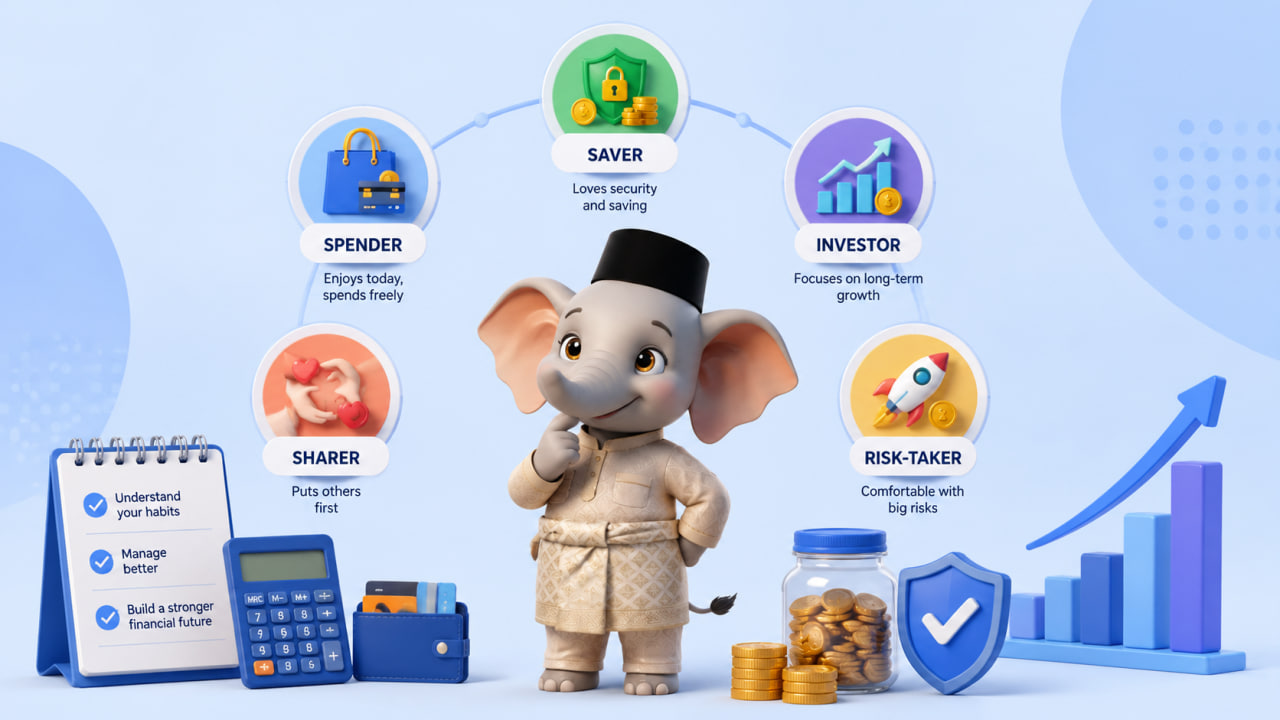
Two people can earn exactly the same salary and end up in completely different financial situations five years later. One builds a healthy emergency fund and pays off debt early. The other struggles to save a single ringgit, even with a decent income. The difference often isn't math – it's mindset. Psychologists and financial researchers call this your money personality type: the mix of habits, emotions and beliefs that shape how you earn, spend, save and borrow.
Understanding your money personality won't rewrite your bank statement overnight, but it explains why budgeting advice that works for a colleague might feel impossible for you. Below are five common money personality types, the signs that you fall into each one, and practical steps to build healthier financial habits around your natural tendencies.
Why Your Money Personality Shapes Your Financial Future
Most financial advice assumes everyone responds to logic the same way: spend less than you earn, save consistently, avoid unnecessary debt. In practice, money decisions are driven as much by emotion, upbringing and financial personality as by arithmetic. A saver and a spender can look at the exact same paycheque and make opposite decisions, not because one is smarter, but because they process financial risk and reward differently.
Recognising your money personality can help you spot the blind spots that lead to problem debt, missed retirement savings, or strained relationships over money – the same issues that drive many households to seek help from agencies such as Malaysia's Agensi Kaunseling dan Pengurusan Kredit (AKPK) each year. The goal isn't to force yourself into a different personality, but to build a money management approach that works with your natural habits instead of against them.
|
Money Personality Type |
Core Trait |
Main Financial Risk |
|
Saver |
Prioritises security and consistent saving |
Underspending and missed growth opportunities |
|
Spender |
Enjoys immediate rewards and experiences |
Overspending and high-interest debt |
|
Sharer |
Generous, puts others' needs first |
Under-saving for personal goals |
|
Investor |
Focused on long-term growth and compounding |
Low liquidity for emergencies |
|
Risk-Taker |
Comfortable with high-stakes financial bets |
Large, fast losses and over-leverage |
The Saver
Savers feel most secure when their bank balance is growing. They are naturally cautious with money, compare prices before every purchase, and rarely carry a credit card balance from month to month. Their spending habits are shaped by a strong need for security, and for many savers this trait is a real strength – it keeps them out of debt and builds a reliable financial cushion.
- You track every ringgit and feel uneasy about unplanned spending.
- You choose the cheapest option available, even for items you use daily.
- You save consistently, even without a specific goal in mind.
- You worry that any spending puts your financial security at risk.
This financial behaviour keeps savers largely debt-free, but it can also mean missed opportunities. Some savers accumulate cash without a clear purpose, missing out on more effective options like a well-planned Employees Provident Fund (EPF) contribution strategy or a proper investment plan that could grow their money faster than a low-interest savings account.
- Give your savings a specific purpose – an emergency fund, a house deposit, or a retirement top-up.
- Review whether "cheap" purchases are actually costing you more through frequent replacement.
- Set a small, guilt-free monthly spending allowance to avoid burnout.
The Spender
Spenders live in the present. They enjoy nice things, spontaneous outings and the newest gadgets, and they're not afraid to pay for quality. This money habit can make life more enjoyable in the short term, but it often comes at the cost of long-term financial stability.
- You make impulse purchases you didn't plan for.
- Shopping or spending helps you feel better after a stressful day.
- Budgeting feels restrictive rather than useful.
- You often reach the end of the month with little or nothing left over.
Left unchecked, this pattern can lead to reliance on credit cards or short-term borrowing to cover regular expenses – a cycle that becomes expensive quickly once interest charges are added.
- Automate a fixed transfer to savings on payday, before you have a chance to spend it.
- Use a values-based budget: decide what truly matters to you and cut spending elsewhere first.
- Add a 24-hour rule for non-essential purchases above a set amount.
The Sharer
Sharers are generous by nature. They contribute to family expenses, help friends in tight spots, and rarely say no to a request for financial support. Their spending habits favour others' needs over their own, which is admirable, but it can leave sharers financially exposed if their own goals are constantly deprioritised.
- You cover others' needs before your own, even when money is tight.
- You find it difficult to decline requests for financial help.
- You'd rather spend on shared experiences than save for yourself alone.
- Supporting family members sometimes means dipping into savings or taking on debt.
Financial counsellors often see this pattern among adults supporting both children and ageing parents at once. Building your own financial stability first ultimately allows you to keep helping others over the long run, rather than risking your own security.
- Set clear limits on how much you can give each month before you start giving.
- Automate your own savings so it's set aside before requests come in.
- Create a dedicated "helping others" fund so generosity doesn't derail your main budget.
The Investor
Investors think in decades, not months. They understand compounding – the way interest earns interest over time – and consistently direct extra income toward long-term growth, whether through retirement savings, unit trusts or the stock market. For this financial personality, the reward comes from watching money grow steadily rather than chasing quick wins.
- You prioritise long-term financial goals over short-term rewards.
- You track how your investments and retirement savings are performing.
- You research before committing money to any financial product.
- You're comfortable holding investments through short-term market swings.
For EPF members, this mindset pays off directly: for the 2025 financial year, EPF declared a dividend of 6.15% for both Simpanan Konvensional and Simpanan Shariah, a reminder of how consistent, long-term contributions compound over time. The main risk for investors is over-committing to long-term assets and having too little liquidity for emergencies.
- Keep three to six months of expenses in an accessible savings account before investing further.
- Review your portfolio's balance between growth assets and cash at least once a year.
- Set aside dedicated time for relationships and experiences, not just financial goals.
The Risk-Taker
Risk-takers are drawn to the thrill of a big financial win. They're comfortable with volatility, quick to try day trading, cryptocurrency or leveraged positions, and often willing to borrow to fund an opportunity they believe in. This financial behaviour carries the highest potential reward – and the highest potential loss.
- You're drawn to high-risk, high-reward financial opportunities.
- You've borrowed money or used leverage to take a financial position.
- Trading or speculative investing forms a significant part of your money strategy.
- A single win or loss can significantly move your monthly finances.
This personality type can build wealth quickly, but losses arrive just as fast, and they can spiral into problem debt if wins are reinvested into bigger bets rather than banked. With Bank Negara Malaysia holding its Overnight Policy Rate at 2.75% through much of 2026, borrowing costs remain relatively moderate – but that doesn't remove the risk of over-leveraging on speculative positions.
- Cap speculative investments to a small, defined share of your overall portfolio.
- Bank a portion of any windfall into savings or debt repayment before reinvesting the rest.
- If borrowing has become difficult to manage, free, confidential help is available through AKPK's Debt Management Programme.
Which Combination Fits You?
Few people match a single type exactly. It's common to be a saver at work and a spender on weekends, or an investor who occasionally takes speculative risks with a small portion of savings. Your money personality can also shift with life stages – a sharer supporting young children may become more of a saver once those responsibilities ease, and a spender who experiences a financial scare often develops saver-like habits almost overnight.
Rather than trying to force yourself into a completely different profile, use these patterns as a mirror. Identify which traits are genuinely working in your favour and which ones are quietly working against your goals.
Quick Reference: Your Next Step by Type
|
Type |
One Habit to Start This Month |
|
Saver |
Give idle savings a specific purpose or investment goal |
|
Spender |
Automate a savings transfer on payday |
|
Sharer |
Set a monthly cap on money given to others |
|
Investor |
Keep 3–6 months of expenses in accessible cash |
|
Risk-Taker |
Cap speculative bets to a small share of your portfolio |
Building a Money Management Plan That Fits Your Personality
Whatever your dominant type, a few money management habits apply across the board:
- Track your income and expenses for at least one full month before making changes.
- Automate savings and bill payments so good habits don't depend on willpower alone.
- Build an emergency fund covering three to six months of essential expenses.
- Review your retirement contributions, including EPF, at least once a year.
- If debt is becoming unmanageable, reach out early – organisations like AKPK offer free financial counselling and structured repayment plans, and a well-chosen personal loan used to consolidate high-interest debt can sometimes cost less than continuing to juggle multiple repayments.
Money personalities aren't fixed labels – they're starting points for building money habits that actually fit how you think and feel about money. The households that manage their finances well aren't necessarily the ones with the highest income; they're the ones who understand their own financial personality well enough to plan around it.