
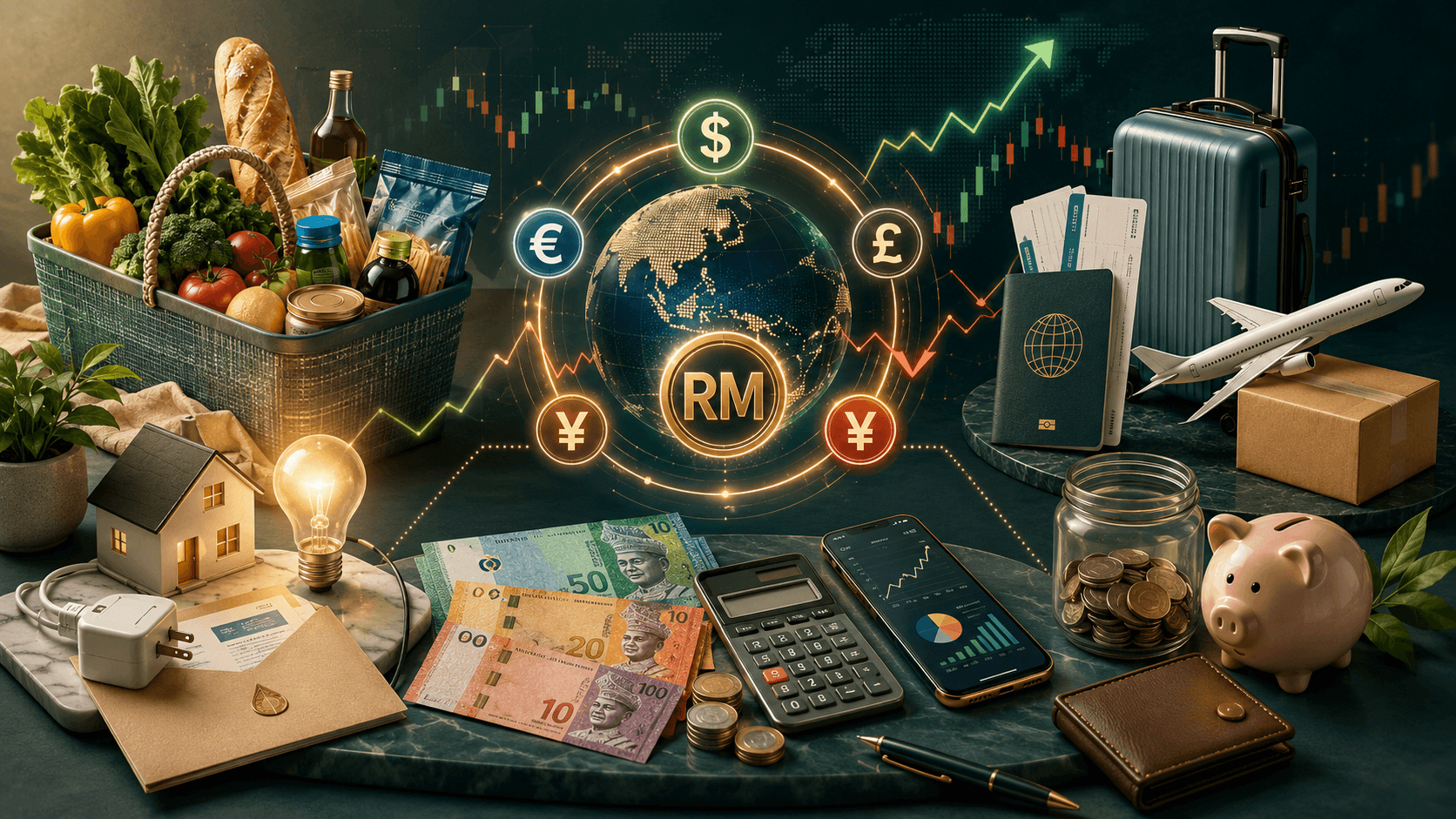
Every time you buy a smartphone, pay a university tuition bill in British pounds, or check whether this month's grocery run feels a little more expensive than last month's, exchange rate fluctuations are likely playing a quiet but consequential role. Currency values shift constantly — influenced by central bank decisions, global trade flows, political events, and market sentiment — and those shifts ripple through household budgets in ways most people don't fully appreciate until the damage is done.
This guide breaks down exactly how exchange rate changes translate into real-world financial consequences, and what practical steps you can take to protect your personal finances when currency volatility rises.
Why Exchange Rates Matter More Than You Think
An exchange rate is the price at which one currency can be exchanged for another. When the ringgit (MYR) weakens against the US dollar (USD) or other major currencies, every transaction that involves a foreign currency becomes more expensive in local terms — whether that's paying for an imported car part, a Netflix subscription billed in USD, or a semester of tuition fees at a UK university.
Exchange rates are not abstract macroeconomic indicators. They are a mechanism that directly transmits global economic conditions into your grocery bill, your loan repayments, and the real value of your investment portfolio. According to Bank Negara Malaysia (BNM), the ringgit's performance against major trading partner currencies is one of the central bank's key monitoring indicators — precisely because currency movements have broad and fast-moving effects on consumer welfare and business conditions.
How a Weaker Currency Raises the Cost of Everyday Goods
Malaysia is a significant importer of consumer electronics, processed foods, vehicles, and industrial inputs. When the MYR depreciates against the USD or euro, the cost of these goods rises in ringgit terms — and retailers typically pass that cost on to consumers.
Consider a concrete example. If a batch of imported electronic components is priced at USD 10,000, and the exchange rate moves from RM 4.40 to RM 4.80 per USD, the same shipment now costs RM 48,000 instead of RM 44,000 — an 8.3% increase driven entirely by the exchange rate, before any supply chain or production cost changes. That margin squeeze flows downstream into the retail price you pay.
Categories most exposed to currency-driven price increases include:
- Consumer electronics (smartphones, laptops, home appliances)
- Imported fresh and processed foods
- Pharmaceuticals and medical devices
- Passenger vehicles and spare parts
- Fuel and energy inputs (globally priced in USD)
According to data from the Department of Statistics Malaysia (DOSM), import-intensive subcategories within the Consumer Price Index (CPI) tend to register faster price acceleration during periods of sustained ringgit weakness.
Travel and Study Abroad: When the Exchange Rate Hits Your Budget
If you're planning an overseas holiday or supporting a family member studying abroad, the exchange rate directly determines how far your ringgit stretches — or doesn't. A 10% depreciation of the MYR against the pound sterling means that a RM 2,000/month living allowance for a student in the UK effectively becomes worth RM 1,820 in purchasing power terms — before any local inflation in the UK is factored in.
Families supporting children at universities in the United Kingdom, Australia, or the United States face some of the most acute exchange rate exposure, since tuition and accommodation fees are set in foreign currency years in advance. Locking in an exchange rate through a forward contract or a multi-currency account can reduce this uncertainty significantly.
For travellers, timing matters. Currency conversion apps such as Wise or XE allow you to monitor real-time rates and convert funds when the rate is more favourable, rather than converting at the airport or on the day of travel.
Foreign Currency Loans and Credit Card Debt: The Hidden Cost
Borrowing in a foreign currency introduces a layer of risk that many people underestimate. If you hold a mortgage, personal loan, or outstanding credit card balance denominated in USD, GBP, or any other currency, the amount you effectively owe in ringgit terms changes every day as the exchange rate moves.
Suppose you borrowed USD 20,000 when USD/MYR was at 4.20 — an effective debt of RM 84,000. If the ringgit subsequently weakens to 4.70 per USD, the same debt is now worth RM 94,000 in local terms — an increase of RM 10,000 without taking on a single new cent of borrowing.
Key actions to take if you carry foreign currency obligations:
- Monitor the relevant exchange rate at least monthly
- Model your repayment schedule under a worst-case depreciation scenario (e.g., 15–20% further weakening)
- Consider accelerating repayments during periods of relative ringgit strength
- Consult a Securities Commission Malaysia-licensed financial planner before restructuring any foreign debt
Your Investment Returns Are Not Safe From Currency Swings
Many investors diversify into foreign assets — US equities, global REITs, or international bond funds — as a hedge against domestic risk. This is a sound strategy, but it introduces a different form of risk: currency risk on the return.
If you hold a US equity fund that returns 10% in USD over a year, but the USD/MYR rate falls by 8% during that period (i.e., the ringgit strengthens), your effective return in ringgit is only around 2% — dramatically lower than the underlying asset performance suggests. Conversely, if the ringgit weakens, your returns are amplified when converted back to MYR.
The Securities Commission Malaysia and the Federation of Investment Managers Malaysia (FIMM) both publish guidance on currency risk disclosures for unit trust and fund products. Before investing in any foreign-denominated asset, review the fund's currency hedging policy — some funds actively hedge back to MYR, others do not.
Remittances: When Exchange Rates Help — and Hurt
For households receiving remittances from family members working in Singapore, Australia, the Middle East, or other higher-income economies, the exchange rate acts as a direct multiplier on income. A weaker ringgit means that each Singapore dollar or Australian dollar sent home converts to more MYR — a genuine financial benefit for recipient households.
However, the picture reverses when the ringgit strengthens. The same foreign currency income translates into less MYR, reducing the real value of support sent home. Households that depend on remittances as a primary income source are exposed to this volatility in a way that salaried workers with locally-denominated income are not.
To manage this exposure: track exchange rate trends using free tools from BNM's official exchange rate page, and consider converting larger lump sums when the rate is favourable rather than converting fixed amounts on a rigid monthly schedule.
Exchange Rates and Inflation: The Invisible Tax on Your Savings
Currency depreciation and domestic inflation are closely linked. When the ringgit weakens, the price of imported inputs — from raw materials to energy to processed foods — rises. These cost increases work their way through the production and distribution chain, raising the price of domestically produced goods and services as well as directly imported items.
The result is a broad erosion of purchasing power: the same ringgit buys less than it did before. For individuals holding most of their savings in cash or fixed deposits, sustained currency-driven inflation silently reduces the real value of those savings, even if the nominal balance remains unchanged.
The International Monetary Fund (IMF) has consistently highlighted that exchange rate pass-through — the degree to which currency movements translate into domestic price changes — is higher in small, open economies with significant import dependence, a category that describes Malaysia's trade structure well.
A Silver Lining: When Exporters and Freelancers Win
Currency depreciation is not uniformly negative. For Malaysian exporters — in sectors such as palm oil, rubber, electronics manufacturing, and business process outsourcing — a weaker ringgit makes their goods and services more price-competitive in global markets. Export revenues, earned in foreign currencies, convert back into more ringgit, improving profit margins or creating room to lower export prices and win market share.
The same dynamic benefits Malaysian freelancers and remote workers earning in USD, GBP, or other major currencies. A weaker MYR means each unit of foreign income is worth more locally, effectively increasing real purchasing power for this group.
The trade-off, however, is real: exporters and freelancers who benefit from a weak ringgit still face higher costs for imported equipment, software, raw materials, and living expenses — so the net benefit depends on each individual's specific income and cost structure.
Practical Strategies to Protect Your Finances During Currency Volatility
Understanding the risks is only useful if it leads to action. Below is a comparison of how a weaker versus stronger MYR affects different groups — followed by concrete strategies for each situation.
|
Group / Situation |
Impact of Weaker MYR |
Impact of Stronger MYR |
|
Consumer of imported goods |
Higher prices, reduced purchasing power |
Lower prices, improved affordability |
|
Student/family with overseas education costs |
Higher effective tuition and living costs |
Lower effective costs, budget relief |
|
Holder of foreign currency loan |
Larger effective debt in MYR terms |
Smaller effective debt in MYR terms |
|
Investor in foreign-denominated assets |
Higher MYR returns on conversion |
Lower MYR returns on conversion |
|
Remittance recipient |
Higher MYR value per unit received |
Lower MYR value per unit received |
|
Exporter / foreign income earner |
Higher MYR revenue on conversion |
Lower MYR revenue on conversion |
Whatever your situation, the following strategies are broadly applicable:
- Diversify across currencies and asset classes. Holding assets in both MYR and foreign currencies — through licensed unit trusts, foreign equity ETFs, or multi-currency savings accounts — reduces the risk that any single currency movement devastates your overall financial position. Work with a licensed financial planner to determine an appropriate allocation for your risk profile.
- Build and maintain a local-currency emergency fund. Keep three to six months of living expenses in a liquid, MYR-denominated account. This protects you from being forced to convert foreign assets at unfavourable rates during a personal financial crisis that coincides with currency weakness.
- Monitor rates actively and transact strategically. Use real-time rate tracking tools (BNM's official page, Wise, XE) to time significant foreign currency transactions — remittance conversions, overseas tuition payments, or foreign investment entries — when the rate is more favourable. Even a 2–3% improvement on a large transaction represents a meaningful saving.
- Consider multi-currency accounts for regular foreign transactions. Several Malaysian banks and licensed e-money operators now offer multi-currency accounts that allow you to hold balances in USD, SGD, or other major currencies and convert when conditions are right, rather than converting on a fixed schedule at whatever rate is available.
- Consult a licensed professional before making major financial decisions. For foreign currency debt restructuring, cross-border investment strategies, or significant remittance planning, always seek advice from a financial planner licensed by the Securities Commission Malaysia or Bank Negara Malaysia. Currency risk carries real consequences, and generic advice cannot substitute for a review of your specific circumstances.
Conclusion
Exchange rate fluctuations are neither a distant macroeconomic abstraction nor a phenomenon that only affects businesses and traders. They are a live variable in your household budget, your savings strategy, and your long-term financial security. The ringgit's value against global currencies shapes what you pay for groceries, whether studying abroad is affordable, how much your foreign investments are worth, and how efficiently remittances support your family.
The goal is not to predict exchange rate movements — even professional economists fail at that consistently. The goal is to understand your exposure, reduce unnecessary risk, and make financial decisions that remain sound across a range of currency scenarios. Start with an emergency fund, diversify thoughtfully, monitor rates when large transactions are approaching, and engage licensed professionals for decisions with significant financial stakes. That combination will serve you far better than trying to time the market.
This article is intended for general informational purposes only and does not constitute financial investment advice. Please consult a licensed financial advisor before making financial decisions.